There have been many times when I have been very busy with school, homework, and everything else that I've thought, "if time could stop for, like, five seconds, even that would make a huge difference." When I start to feel stressed, I tend to tune out the things that are going on around me. Usually I'm listening to music, and don't quite realize that I'm not 100% focused on what I should be doing. Sometimes I will be listening to music on my commute to or from school, and realize I can't remember how I got from my apartment to Haymarket - but somehow I did, and amazingly, I'm still on time...
To create the feeling of time stopping, I slowed down the speed of certain video clips and used slow transitions between shots. To show time passing I used shots that can be easily recognized: people walking down the street, a market, my feet, etc. Since time cannot literally be stopped, the shots that show time at a standstill are somewhat abstract. I also chose an instrumental song called "Time Stops" by Explosions in the Sky which plays through out the whole video. The song is to help make the connection that each event is happening within the same short span of time; to act as a narration of some sort.
Sunday, May 6, 2007

Monday, April 30, 2007
Artist Statement
There have been many times when I have been very busy with school, homework, and everything else that I've thought, "if time could stop for, like, five seconds, even that would make a huge difference." When I start to feel like this, I space out and tune out everything around me; I suppose it's my own way of making time stop. What I'm hoping to create is a moment like that for the viewer; a moment when things are easy to tune out, but still have something that keeps the person engaged.
Wednesday, April 18, 2007
Proposal
There have been so many times in my life when I've been really overwhelmed with school work and life in general that I think to myself, "If time could stop just for an hour, that would be the biggest help ever," and I'm sure I'm not the only one who feels this way. So, for my final project I want to make time stop using digital images, sound, and possibly video.
I'm still working on ideas of what the subject matter of the photos would be, but I want to try experimenting with a series of images shown in conjunction with music; specifically an instrumental called "Time Stops" by Explosions in the Sky. I chose this song not for its title, but because when I first heard it, it felt like time had actually stopped...
One idea that I had was to record a video of the city... the cars passing, people walking, etc. The video will have sound that's almost overwhelming - have the video start out at a regular tempo, but the sounds a complete sensory overload... Gradually, the video and the sounds will slow down, and once the video was at a standstill I'd start using photographs and the song. After a few pictures, I'd gradually introduce the video again.
I'm still not sure if the photographs will have the same content as the video, but once I start the project, I'll be able to figure out this.
I'm still working on ideas of what the subject matter of the photos would be, but I want to try experimenting with a series of images shown in conjunction with music; specifically an instrumental called "Time Stops" by Explosions in the Sky. I chose this song not for its title, but because when I first heard it, it felt like time had actually stopped...
One idea that I had was to record a video of the city... the cars passing, people walking, etc. The video will have sound that's almost overwhelming - have the video start out at a regular tempo, but the sounds a complete sensory overload... Gradually, the video and the sounds will slow down, and once the video was at a standstill I'd start using photographs and the song. After a few pictures, I'd gradually introduce the video again.
I'm still not sure if the photographs will have the same content as the video, but once I start the project, I'll be able to figure out this.
Monday, April 16, 2007
"Expanding the Image Breaking the Narrative"
The movie that I watched was Eternal Sunshine directed by Micheal Gondry.
The clip from the movie that I chose the main character, Joel, is going to see Dr. Mierzwiak for his first treatment to forget Clementine. It starts with Joel sitting in a chair in one of the rooms of the office, hooked up to a machine. There are two doctors who are putting objects from Joel's relationship on a table to get him thinking about the memories attached to those specific items, so that the memories can be erased. The is a cut from Joel in the chair in the office to him in his bed in his home, hooked up to a different machine with one of the doctors erasing the memories he is having while he sleeps. From this point on, there are many dream-like/flashback sequences that Joel has about his memories with Clemetine.
The transitions used between shots to go from what is actually happening in the scene, to what Joel is seeing in his head, are non-sequitor in nature. One of the shots is of Joel watching himself during the first proceedure, and then as time passes, what happens makes less and less sense. For example, there is a shot of Joel coming out of his apartment with two trash bags, on his way to the doctor's office, and then the shot changes from a medium shot to an over the shoulder shot, and we see Joel sitting on the sidewalk hooked up to the equipment. The shots are quit cuts, and the tempo is sped up a lot as time moves along during the time we're on Joel's head.
Overall, I was impressed with the way the whole movie came together in the end.
I liked the way the music was used as a way to add to the mood of certain scenes... I think it helped me relate to Joel's character since going to a doctor to have your memory erased isn't something people can say they have done. Sometimes the music added to the overwhelmed/anxious mood of a scene...
The clip from the movie that I chose the main character, Joel, is going to see Dr. Mierzwiak for his first treatment to forget Clementine. It starts with Joel sitting in a chair in one of the rooms of the office, hooked up to a machine. There are two doctors who are putting objects from Joel's relationship on a table to get him thinking about the memories attached to those specific items, so that the memories can be erased. The is a cut from Joel in the chair in the office to him in his bed in his home, hooked up to a different machine with one of the doctors erasing the memories he is having while he sleeps. From this point on, there are many dream-like/flashback sequences that Joel has about his memories with Clemetine.
The transitions used between shots to go from what is actually happening in the scene, to what Joel is seeing in his head, are non-sequitor in nature. One of the shots is of Joel watching himself during the first proceedure, and then as time passes, what happens makes less and less sense. For example, there is a shot of Joel coming out of his apartment with two trash bags, on his way to the doctor's office, and then the shot changes from a medium shot to an over the shoulder shot, and we see Joel sitting on the sidewalk hooked up to the equipment. The shots are quit cuts, and the tempo is sped up a lot as time moves along during the time we're on Joel's head.
Overall, I was impressed with the way the whole movie came together in the end.
I liked the way the music was used as a way to add to the mood of certain scenes... I think it helped me relate to Joel's character since going to a doctor to have your memory erased isn't something people can say they have done. Sometimes the music added to the overwhelmed/anxious mood of a scene...
Tuesday, April 3, 2007
Sounds 2
I hate loud noises and things that are hard to tune out. I don't like being in a car with the music blasting, I hate that screeching noise the T makes when it pulls away, I don't like the television to be too loud, the noise my alarm clock makes my skin crawl, and I don't like the sound of the vacuum when it first turns on. The only loud noises that I don't mind are sirens. I've always lived in the city, so I'm used to hearing sirens every hour or so.
I've always liked the noises of high heel shoes on hard surfaces, I'm not sure what it is I like about the sound, though. I like the sound of a train's whistle because I lived fairly close to the Lowell train station. Throughout the summer I could always hear it at night, for some reason it's a very comforting sound. I also like the sound pebbles make when you walk through them.
When I was younger I paid more attention to sounds. I remember listening to the blood swish through my ears when I was little and wondering what that sound was. Sometimes I'd make words out of the crunching of my food, like, I'd crunch Mary has a Little Lamb or something.
I've always liked the noises of high heel shoes on hard surfaces, I'm not sure what it is I like about the sound, though. I like the sound of a train's whistle because I lived fairly close to the Lowell train station. Throughout the summer I could always hear it at night, for some reason it's a very comforting sound. I also like the sound pebbles make when you walk through them.
When I was younger I paid more attention to sounds. I remember listening to the blood swish through my ears when I was little and wondering what that sound was. Sometimes I'd make words out of the crunching of my food, like, I'd crunch Mary has a Little Lamb or something.
Tuesday, March 20, 2007
Sounds
I wanted to write this before I forgot...
I've been thinking about the way my source would sound if it were a noise - and you know when you're in a packed auditorium or resturaunt, and everyone is talking, but you somehow manage to hear one conversation clearly. That's what my source would sound like, the conversation that stands out in a room full of numerous other conversations.
I was also thinking that if it were music, it would probably be an instrumental - most likely foreign sounding, or something that you wouldn't normally think to listen to unless someone suggested it.
I've been thinking about the way my source would sound if it were a noise - and you know when you're in a packed auditorium or resturaunt, and everyone is talking, but you somehow manage to hear one conversation clearly. That's what my source would sound like, the conversation that stands out in a room full of numerous other conversations.
I was also thinking that if it were music, it would probably be an instrumental - most likely foreign sounding, or something that you wouldn't normally think to listen to unless someone suggested it.
Monday, March 19, 2007
Source Project
From doing this assignment I learned that communicating my source was a lot harder than I thought it would be. I realized that what it comes down to is that it really is just things that inspire me. I just like random things - the way light posts line up, the way the wind might blow open a newspaper that was thrown on the side walk, the interesting physical features of a person, etc. I was apprehensive to take new pictures for this project because I didn't want to be trying too hard. So I looked through boxes of old pictures that I've taken over the last five years and found pictures that I felt showed what I was getting at.
The second hardest part was figuring out how to present them. I thought of putting them into a collage, but I didn't want to cut up the pictures in case I thought of something better to do with them. Finally, I just decided to mount them on black poster board because I wanted to show that there was no vague, hidden message. I just like things...
The second hardest part was figuring out how to present them. I thought of putting them into a collage, but I didn't want to cut up the pictures in case I thought of something better to do with them. Finally, I just decided to mount them on black poster board because I wanted to show that there was no vague, hidden message. I just like things...
Monday, March 12, 2007
Sand Mandala Response

The the design that was created symbolized compassion. Each color incorporated in the design represents one of the four elements. The green makes a fifth element - space.

The monk made designs with a toothpick in the sand. Just before I left, he started to fill in the design with red sand.

These are the offerings that were placed on the altar. On the wall behind the table were textiles with the image of the Buddha on them.
Before the monk started constructing the sand mandala, he talked to the group about what Buddhism is about. He said that Buddhism teaches about ending the suffering in your life by learning how to be content with the things that you have, showing compassion towards other people, and living your life in the present moment - don't focus on the things you should have done, and don't think about things that are too far ahead in the future. Which is a roundabout way of saying happiness is found within yourself, and not the material objects the world has to offer.
I agree a lot with the Buddhist teachings. I think a person can only be happy by making the changes that they want to see in themselves. I learned a little about Buddhism last year and one of the teachings that change is neutral, the person who is experiencing the change makes it a positive or a negative. From personal experience, I've become a happier person keeping this in mind.
Saturday, March 3, 2007
Photos Illustrating Time Based Concepts (Part B from 2/12/07)


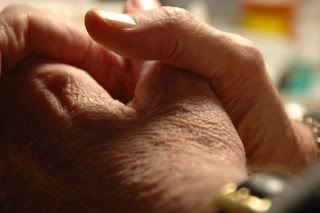
These three pictures illustrates a duration of time. The poses show that time is going by slowly.
 Wide shot
 Close up
 My Inspiration
My very first inspiration to even pick up a camera came from my family. My dad is a woodworker, and a lot of the furniture in the house was made by him. My grandmother is a painter and there are various paintings of my brother and I hanging in my mom's house. Various other relatives have (or have had) a profession involving art; graphic design, ballet, and music. One of my cousins graduated from MassArt a few years ago, and another cousin is graduating this semester. Both of my parents have always encouraged my brother and I to do the things that make us happy, all within reason, of course. Having constant exposure to artists, and constant support for my own art, has been a true inspiration to even want to pursue a career in photography.
As far as creating artwork goes, I feel that art is very theraputic and one of the things that inspires me is the things that I don't want to talk about. I find that my artwork is more true to my emotions, in the respect that I am not always willing to let people see on my face and in my actions the things I feel. One specific thing that inspired me to create art as my parent's divorce two years ago. I found that I wasn't willing to let it show that it was something that was on my mind and bothering me. So a lot of my art began to reflect what I was feeling, just to get the emotions out so that I could move on. Which is a long winded way of saying I'm inspired by my emotions to my life experiences.
When it comes to my photography, I'm inspired by life's minor details. My english professor wears black shoes with blue shoelaces. The first time I noticed, I obsessed over it until I got a chance to write it down. I think that it's because of this, my pictures are "documentations of objects" as I was told last semester. I write a lot, just the things I see and whatnot, and I treat photography as a quicker way to jot down my observations. I just like having a documentation of things I've, and I'm not sure why.
A third inspiration comes from my longtime fascination with foreign cultures and languages - primarily those from Asia. For as long as I can remember I have been curious to know how people in other parts of the world live. My high school offered Khmer as one of their language courses, and I took that for three years. One of my friends is Indian and a couple summers ago she went to visit her family in Tamil, India. She brought back a lot of pictures, clothing, and jewelry, and all I could think about looking through the pictures and whatnot was, "I have to go there." Some day I really hope I can go to Cambodia and/or India, or any foreign country for that matter, and photograph the things I see.
As far as creating artwork goes, I feel that art is very theraputic and one of the things that inspires me is the things that I don't want to talk about. I find that my artwork is more true to my emotions, in the respect that I am not always willing to let people see on my face and in my actions the things I feel. One specific thing that inspired me to create art as my parent's divorce two years ago. I found that I wasn't willing to let it show that it was something that was on my mind and bothering me. So a lot of my art began to reflect what I was feeling, just to get the emotions out so that I could move on. Which is a long winded way of saying I'm inspired by my emotions to my life experiences.
When it comes to my photography, I'm inspired by life's minor details. My english professor wears black shoes with blue shoelaces. The first time I noticed, I obsessed over it until I got a chance to write it down. I think that it's because of this, my pictures are "documentations of objects" as I was told last semester. I write a lot, just the things I see and whatnot, and I treat photography as a quicker way to jot down my observations. I just like having a documentation of things I've, and I'm not sure why.
A third inspiration comes from my longtime fascination with foreign cultures and languages - primarily those from Asia. For as long as I can remember I have been curious to know how people in other parts of the world live. My high school offered Khmer as one of their language courses, and I took that for three years. One of my friends is Indian and a couple summers ago she went to visit her family in Tamil, India. She brought back a lot of pictures, clothing, and jewelry, and all I could think about looking through the pictures and whatnot was, "I have to go there." Some day I really hope I can go to Cambodia and/or India, or any foreign country for that matter, and photograph the things I see.
Monday, February 12, 2007
Research Response Project 3
For my research I watched the film The Jacket directed by John Maybury. This was the first Hollywood movie for Maybury, who is an independent filmmaker from England. To make this film, Maybury found inspiration in silent fims, and films from the 1960-70's such as The Parallax View.
The interpretation of the film's plot is left up to the viewer, although director John Maybury claims this is not a movie about time travel. The Jacket is a psychological thriller about a man named Jack who is institutionalized because he is believed to have murdered a police officer, but Jack has no recollection of committing the crime. Since Jack cannot remember he is placed in a hospital for the criminally insane. Throughout the story, Jack has dream/flashback-type moments when he "travels" through time and pieces together the crime he was thought to have committed, and sorts out the mysteries occurring in the lives of the people he has been connected with.
I chose a three minute clip of Jack receiving treatment in the hospital. The scene starts off with a long shot of the hospital and then cuts to another long shot of Jack and a few doctors walking down the hallway. The next cut shows three or four doctors and Jack in a room where Jack will receive his treatment. However, Jack doesn't believe the treatments are helping him and he tries to fight back. To illustrate the intensity of the scene, there are quick cuts between Jack, who grabs a straight jacket from the wall, and Jack hitting one of the doctors with the straight jacket. Once Jack has been restrained, the doctor who he hit leaves the room, leaving two other doctors to strap jack into a straight jacket and get him into the drawer. As the doctors are strapping Jack onto the gerny, there is an aspect-to-aspect transition within the scene involving Jack being strapped in and shoved into the draw, and the doctor who was hit in his office talking with another doctor. While Jack is being strapped in, there are multiple extreme closeups of the buckles being buckled. The aspect-to-aspect shots end with a wide shot of a doctor closing the drawer that contains Jack. While Jack is in the drawer there are extreme close ups of one of his eyes, where flashbacks of Jack's life are shown. The scene ends with Jack in another point in time, no longer at the hospital.
The interpretation of the film's plot is left up to the viewer, although director John Maybury claims this is not a movie about time travel. The Jacket is a psychological thriller about a man named Jack who is institutionalized because he is believed to have murdered a police officer, but Jack has no recollection of committing the crime. Since Jack cannot remember he is placed in a hospital for the criminally insane. Throughout the story, Jack has dream/flashback-type moments when he "travels" through time and pieces together the crime he was thought to have committed, and sorts out the mysteries occurring in the lives of the people he has been connected with.
I chose a three minute clip of Jack receiving treatment in the hospital. The scene starts off with a long shot of the hospital and then cuts to another long shot of Jack and a few doctors walking down the hallway. The next cut shows three or four doctors and Jack in a room where Jack will receive his treatment. However, Jack doesn't believe the treatments are helping him and he tries to fight back. To illustrate the intensity of the scene, there are quick cuts between Jack, who grabs a straight jacket from the wall, and Jack hitting one of the doctors with the straight jacket. Once Jack has been restrained, the doctor who he hit leaves the room, leaving two other doctors to strap jack into a straight jacket and get him into the drawer. As the doctors are strapping Jack onto the gerny, there is an aspect-to-aspect transition within the scene involving Jack being strapped in and shoved into the draw, and the doctor who was hit in his office talking with another doctor. While Jack is being strapped in, there are multiple extreme closeups of the buckles being buckled. The aspect-to-aspect shots end with a wide shot of a doctor closing the drawer that contains Jack. While Jack is in the drawer there are extreme close ups of one of his eyes, where flashbacks of Jack's life are shown. The scene ends with Jack in another point in time, no longer at the hospital.
Monday, February 5, 2007
Response to James Turrell
Last weekend I went to the ICA to see James Turrell's work at the ICA. His piece was in a separate room in one of the galleries. The piece was a rectangle of a solid shade of red light. From a distance the light looked as if it was being projected onto a wall, or a solid red rectangle moutned onto the wall; nothing too impressive. But when I got closer, I realized that the light was filling a 3-D space. It was interesting seeing the red light as a solid rectangle mounted onto a wall, and then getting close to it and realizing it was something you could put your hands through. Actually being able to see James' Turrell's work at the ICA allowed me to appreciate his work a lot more than I had before.b

Monday, January 29, 2007
Camera Obscura
Before today I had used a pinhole camera a couple times, so I knew the image would be upside down and a negative projection. The first time we looked at the image, it was on a medium size piece of paper and the image appeared immediately. I could clearly see the upside down image of the courtyard projected onto the paper. When we took the medium paper away to see the image on the white wall, the image wasn't as clear. I could see where the sky should be on the bottom and the building above it, but it was a lot harder for my eyes to focus to see the actual image. I think if I saw, or at least knew, what was projected onto the wall before hand it would have been a little easier to focus.
This is a drawing of the image from the second camera. My drawing doesn't do much justice to the true image because the ball was a lot more 3-D.
This is a drawing of the image from the second camera. My drawing doesn't do much justice to the true image because the ball was a lot more 3-D.
Sunday, January 28, 2007
Analysis
 This image was taken at 11:10am when the clouds started to ease up. The space is framed by tall apartment complexes on all sides that do not let too much sun light into the street. Once your eye travels to the top of the buildings, the image seems to stop abruptly. This could be because there is little variation in the colors; everything seems washed out and gray. Cars line the right ride of the street and don't seem to reflect much of the sun. If you look at the picture from the bottom to the top, the image is weighed down by the color of the dark concrete and asphault. The clouds make the space look dark, cold, and somewhat smaller than it is in person.
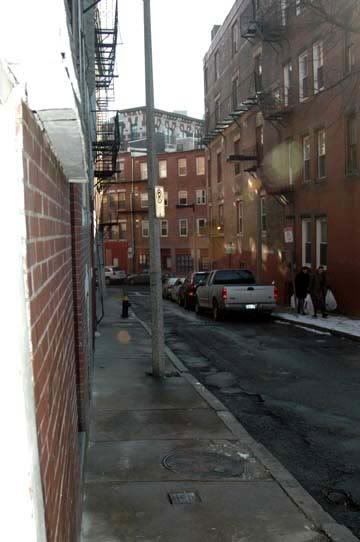 This image was taken at 2:10pm. Just above the row of parked cars, you can see the reflections of windows from the building on the left. In the area of fire escape on the left there is patch where the sun is clearly hitting, also giving the series of windows on the upper level of the building straight ahead an orange glow. The people walking next to the building on the right give the viewer an idea at how large the buildings in the space are. One can assume the buildings are fairly large because the first row of windows allign with the heads of the two people. Unlike the first picture, looking from bottom to top, the space seems to slightly taper off. This could be because the sun allows a variation in the colors of the space. The space in this picture appears to be slightly bigger, and even warmer, compared to the first image.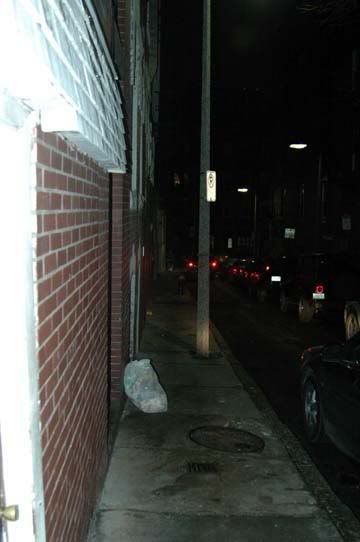
This image was taken at 5:30pm just after the sun set. The space is mainly illuminated by the camera's flash, and the passing car's headlights. The headlights of the passing car are reflected on the tail lights of the parked cars, allowing the viewer to make a guess at the size of the space.
I'd describe the second picture, the most interesting time of day, to someone who was blind as the way a candle stick would feel right after the flame was blown out. Starting at the ground, the colors are cool shades of gray, even the brick is a cool shade of red. As you get closer to the top of the image, the sun shines on portions of the buildings, and the bricks are warm shades of red (especially in the building that is straight ahead). As a whole, the image tapers off at the top. A candle stick is cool, and somewhat wider at the bottom, and thinner and warmer towards the top where the flame once was. However, the flame would no longer be lit because the sun cannot be seen, and the temperature at this time of day was not particularly warm.
I'd describe the second picture, the most interesting time of day, to someone who was blind as the way a candle stick would feel right after the flame was blown out. Starting at the ground, the colors are cool shades of gray, even the brick is a cool shade of red. As you get closer to the top of the image, the sun shines on portions of the buildings, and the bricks are warm shades of red (especially in the building that is straight ahead). As a whole, the image tapers off at the top. A candle stick is cool, and somewhat wider at the bottom, and thinner and warmer towards the top where the flame once was. However, the flame would no longer be lit because the sun cannot be seen, and the temperature at this time of day was not particularly warm.
Research Questions
1. Who were they?
Ancient Egyptians
2. Why did they keep time?
Farmers kept time to figure the times best for cultivating and harvesting crops. Preists and astronomers of Ancient Egypt kept time to determine the exact time to perform daily rituals, and to hold major religious festivals.
3. Did their relationship to time relfect inherent beliefs?
Yes, the Ancient Egyptian's relationship to time did reflect inherent beliefs. The fact that preists and astronomers had a specific use for time keeping (to determine the time for daily rituals and important religious festivals) demonstrates the strong connection the Egyptians had to their religion.
4. What did they keep time with?
The Egptians first kept time with a shadow clock, and later they began to use a water clock.
5. Who were the time keepers
Time keepers were farmers, priests, and astronomers.
Ancient Egyptians
2. Why did they keep time?
Farmers kept time to figure the times best for cultivating and harvesting crops. Preists and astronomers of Ancient Egypt kept time to determine the exact time to perform daily rituals, and to hold major religious festivals.
3. Did their relationship to time relfect inherent beliefs?
Yes, the Ancient Egyptian's relationship to time did reflect inherent beliefs. The fact that preists and astronomers had a specific use for time keeping (to determine the time for daily rituals and important religious festivals) demonstrates the strong connection the Egyptians had to their religion.
4. What did they keep time with?
The Egptians first kept time with a shadow clock, and later they began to use a water clock.
5. Who were the time keepers
Time keepers were farmers, priests, and astronomers.
Monday, January 22, 2007
James Turrell

James Turrell's work involves the interaction of light and space. I thought that James Turrell's Roden Crater was an interesting concept; a means for a human to feel one with the entire atmosphere. A person can go inside the crater and view the sky from an elliptical shaped opening in the ceiling, allowing the veiwer only to see a minimal amount of space outside of the crater. A brilliant concept, indeed, although I think it would hardly be worth the "two mariages and one relationship" Turrell claims it costed him.
Subscribe to:
Posts (Atom)